What Is Pilates And What Does It Do For Your Body?
What Is Pilates | Benefits | What To Expect | Resistance Training | Weight Loss | Toning | Back Pain | Difficulty | Men | FAQs
Pilates has been around since the 1920s but has grown more popular than ever, with different types of Pilates featuring on the top fitness trends in our annual Fitness Report for the last four years.
Despite this, many people still wonder what Pilates is, how Pilates works, and whether it can really change your body. From improving posture to building strength and easing back pain, Pilates offers so many benefits. In this guide, we break down how it works, how it's different to other workouts, and whether it's right for you.
Quick Summary
- Pilates is a low-impact exercise focusing on controlled movements
- It improves core strength, flexibility, balance, and body awareness
- Pilates workout exercises can help you lose weight and tone up
- It's suitable for beginners, men and women, and people with back pain
- Pilates is different to yoga and strength training and offers different benefits
What is Pilates?
The origins and principles behind Pilates
Pilates was developed in the early 20th century by Joseph Pilates, who originally called it "Contrology". This system was built around six core principles: concentration, control, centring, precision, breathing, and flow, and involved following a 34-exercise sequence in a set order.
While Pilates has evolved, these pillars still underpin modern Pilates and explain why the exercises feel so different from traditional gym workouts and yoga. Read more on the difference between Pilates and yoga here and the difference between Pilates and weight training here.
Pilates today
Today, Pilates has branched out and there are now multiple variations. The main types of Pilates are:
Classical Pilates – this follows the original flow designed by Joseph, including exercises on the mat and with some kit.
Mat Pilates – this focuses on mat-based exercises using bodyweight or small items like resistance bands and light dumbbells.
Reformer Pilates – utilises a Reformer machine to challenge or assist exercises.
Contemporary Pilates – this combines Pilates with modern training techniques and rehab principles.
Other variations include Wall Pilates (which uses a wall to add or reduce resistance), Power Pilates (which combines Pilates and HIIT), and Yogalates (which blends yoga and Pilates).
While each of these Pilates will vary, the principles remain the same: using slow, controlled movements to strengthen the body from the inside out and prioritising core stability, posture, breathing, and precision rather than fast movements or heavy weight.
What does Pilates do?
The aim of Pilates is to improve how your body moves and feels by strengthening deep stabiliser muscles and creating better alignment across the body. Pilates workouts and exercises strengthen the core and the smaller stabilising muscles throughout the body, improves body awareness, coordination, and balance, and increases your range of movement.
In a nutshell: you’ll feel stronger and more mobile, have better posture, and be less likely to experience injuries.
What happens during a typical Pilates workout?
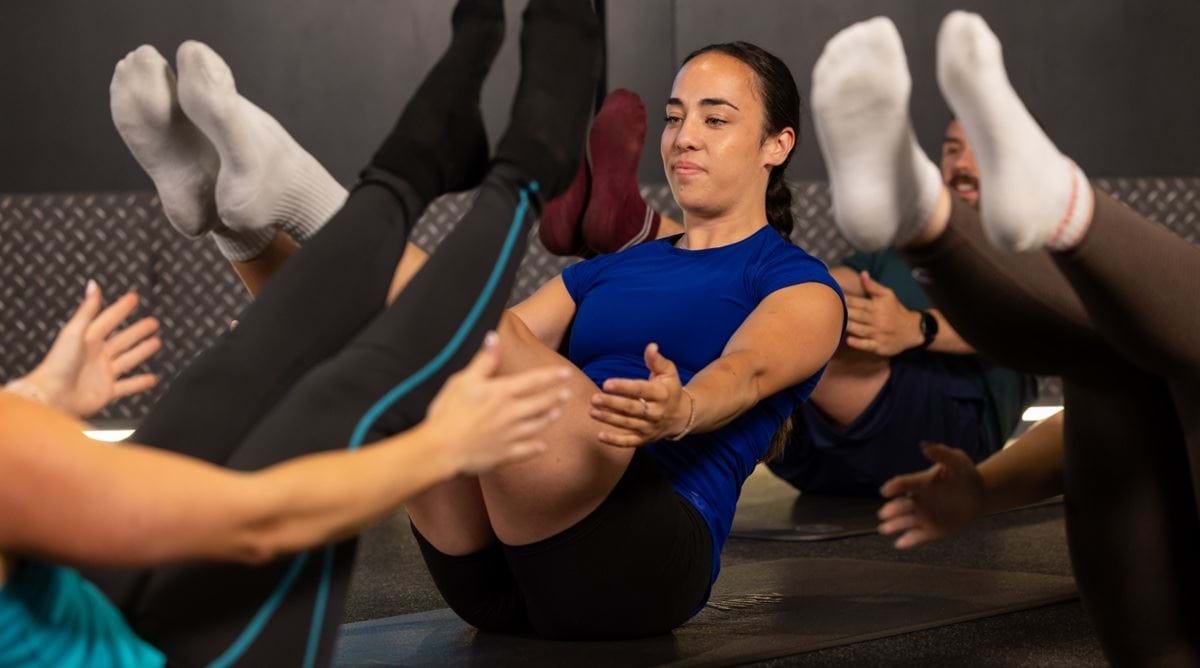
Pilates classes can look different depending on what style of Pilates it is, how long the class is, and who is teaching it. However, a typical Pilates class includes:
Warm up: classes begin with a gentle warm up
Exercises: you will do a mix of core exercises and exercises focused on building strength, stability and mobility throughout the body
Breathing: there will be a focus on deep, controlled breathing aligned to your movement
Mind body connection: you'll focus on alignment and engaging the right muscles to improve mind body connection
Is Pilates a form of resistance training?
Pilates is very different to traditional strength training and prioritises bodyweight movements, so is Pilates resistance training?
Although there are no heavy weights in Pilates, Pilates exercises use your bodyweight as resistance, and classes often use items like yoga balls, resistance bands, and light dumbbells to create additional resistance too.
So yes – Pilates is a form of resistance training and will build muscular strength, stability, and endurance. However, while Pilates will build muscle tone it isn't particularly effective for building significant muscle mass due, especially compared to lifting heavy weights.
Is Pilates good for weight loss?
Pilates workouts are great for building lean muscle tone, but can Pilates help you lose weight? While Pilates can support fat loss by building lean muscle and encouraging movement, the workouts do not burn a high number of calories and are unlikely to cause weight loss alone.
If your goal is to lose weight or burn fat, it is best to achieve this by creating a calorie deficit in your diet and using cardio to boost your overall calorie expenditure and resistance training to build muscle.
How does Pilates tone your body and can it build muscle?
Pilates improves muscle definition by strengthening the muscles, which is what leads to a ‘toned’ appearance. However, while Pilates can build muscle, it’s unlikely that you’ll experience significant muscle gain through Pilates alone.
Building muscle takes long periods of continuously overloading the muscles, and the lack of weights in Pilates makes it hard to place enough tension on the muscle fibres over time to stimulate muscular hypertrophy.
Is Pilates good for back pain and posture?
One of the biggest benefits of Pilates is spinal support and help with back pain (both improving it and preventing it). Pilates strengthens the deep core muscles that support the spine and teaches better movement patterns. This can help reduce tension and discomfort, improve chronic back pain, and help reduce the likelihood of back issues in future.
Is Pilates hard or is it suitable for beginners?
While Pilates is challenging, it is beginner friendly. Pilates exercises can be adapted to suit all abilities, and you are able to take breaks or slow down if needed. Many classes offer variations for exercises, with beginner to advanced options to try.
Equipment-based Pilates like Reformer is a little more technical than mat Pilates, but every type of class is suitable for beginners and Pilates instructors are there to help you get started and progress at your own pace.
Can men do Pilates?
Yes – while women are more likely to do Pilates, men can benefit from classes and workouts just as much as women. In fact, men are often less flexible than women and may benefit more from improving their mobility!
Lots of elite athletes across all sorts of sports use Pilates to strengthen their core, avoid back pain, and improve their performance in the gym and sports. Pilates is suitable for anyone wanting to move better and feel stronger, and it's not gender-specific.
Frequently asked questions about Pilates
Most people will notice improvements in strength and endurance within a couple of weeks, with noticeable improvements in muscle tone taking a couple of months of consistent Pilates workouts. If Pilates is your main form of exercise, we’d recommend doing 2-4 sessions a week to see improvements. If you already strength train, adding in 1-2 sessions a week will be enough.
Yes, mat Pilates can be done at home with no equipment at all. You can find Pilates workouts online to follow or join an online Pilates studio.
Mat Pilates is performed on a yoga mat using bodyweight exercises, as well as some props such as resistance bands or light dumbbells. Reformer Pilates are carried out on a Reformer machine, using this to add or reduce resistance to exercises. Reformer Pilates also has its own unique exercises.
Pilates is a great workout but we’d recommend including cardio and weight training in your weekly routine to ensure you are strengthening the cardiovascular system and increasing muscle mass.
Pilates is low-impact and can be adapted to suit all levels, making it a great choice for older adults. It helps with balance, coordination, stability, and posture, all areas which can become worse with age.
Pilates can support fat loss when combined with a calorie deficit, but doing Pilates alone is not an effective fat loss method. Combine Pilates with a moderate calorie deficit and regular exercise if fat loss is a goal.
Pilates is a great way to build strength, improve posture, and feel more in control of your body at any age or fitness level. Whether you're new to exercise, or looking for a way to complement your current training, Pilates can help you move better and feel stronger. Find a Pilates class at your local PureGym to get started today.
Related Articles