Four 20-Minute HIIT Workouts
Choose your HIIT workout | Effectiveness of 20 minutes of HIIT | Four 20-minute HIIT workouts | FAQs
Page last updated: 8th January 2025
High Intensity Interval Training, commonly known as HIIT, is a workout style that alternates periods of intense exercise with periods of rest. Because HIIT involves maximum exertion during the exercise periods, the workouts are designed to be short -- if you can keep up this level for over 30 minutes, it's likely you're not working hard enough!
Almost any type of training can be conducted in HIIT format, from running to weightlifting. Today, we'll be looking at the benefits of doing a 20-minute HIIT workout and sharing four different HIIT workouts you can do in 20 minutes.
You can learn more about HIIT and its benefits here.
In summary:
- HIIT works by alternating intense bursts with short rest to raise heart rate quickly.
- You can do HIIT with bodyweight, weights, treadmills, or a stationary bike.
- Twenty minutes is enough to improve fitness, boost calorie burn, and support weight loss.
- Pick the workout that best fits the kit you have, your fitness level, and how much impact you prefer.
Choose your 20-minute HIIT workout
We've shaped four 20-minute workouts to suit different goals, equipment and fitness levels:
- Want to build strength as well as cardio? Jump straight to our 20-minute HIIT workout with weights
- Prefer a machine-based workout? Jump straight to the 20-minute HIIT treadmill workout
- New to HIIT or easing back in? Jump straight to the 20-minute HIIT workout for beginners
- Want a low-impact cardio blast? Jump straight to the 20-minute stationary bike HIIT workout
Why are 20 minutes of HIIT so effective?
A lot of people think that more is more when it comes to working out, but you don't have to spend hours at the gym each day to see results. In fact, it's much better to spend 20 minutes working out each day, than 1 hour once a week!
HIIT works so well in a short time because it pushes you into near-maximal effort, where your body can't supply enough oxygen to the muscles. When this happens, you switch to anaerobic energy production, relying on stored fuel instead of oxygen. After the session, your body has to replenish those stores. This process burns additional calories for hours, not just during the workout.
This intense effort also improves how efficiently your body uses oxygen over time, supporting stronger cardiovascular fitness and a healthier heart. There's also some evidence that HIIT workouts increase human growth hormone. This hormone helps to stimulate muscle growth and regulate fat metabolism, which is helpful if you are trying to build muscle or lose fat.
Four 20 minute HIIT workouts to try
We've shared four different HIIT workouts below to give a go.
If you're new to HIIT or have joint issues, start slowly and use low-impact variations. Listen to your body and stop if you feel sharp pain.
20 minute HIIT workout with weights
Duration: 20 minutes (including warm up and cool down)
Equipment: Two dumbbells
Format: 45 seconds on / 15 seconds rest; 4 rounds
Choose this workout if:
- You want a strength-focused HIIT session using dumbbells.
- You're looking for a workout that hits several muscle groups while keeping intensity high.
- You prefer intervals where form and power output matter more than constant speed.
- You want a routine that's easy to progress by increasing weight or tempo.
Warm up - 2 minutes
30 seconds jogging on the spot
30 seconds plank walk outs
Stand tall, then hinge forward at the hips, keeping a straight spine and bring your hands to the floor
Engage your core and walk your hands forward until you are in a plank position
Hold the plank for a second and then walk back until you are standing
Repeat
30 seconds jumping jacks
Stand with your feet together and arms by your sides
Jump up and push your feet out so that you land between hip and shoulder-width apart. As you jump, push your arms up to shoulder height
Jump again, this time bringing your feet back together, and arms by your sides
Repeat
30 seconds punches
Stand with feet hip-width apart and hold your hands in front of your chest as fists, elbows by your side
Engage your core and punch the right arm forward, driving the movement from the hip
Return to the starting position and repeat on the other side
Repeat
Workout - 16 minutes
Perform each exercise for 45 seconds, with a 15-second rest. Do the circuit four times.
Squat to overhead press
Grab a dumbbell in each hand and hold in front of your chest, then adopt a hip-to-shoulder-width foot stance
Squat down by sinking the hips down to parallel
As you return to standing, push the dumbbells up to the ceiling by extending your arms
As you squat down, bring the dumbbells back to chest height
Repeat
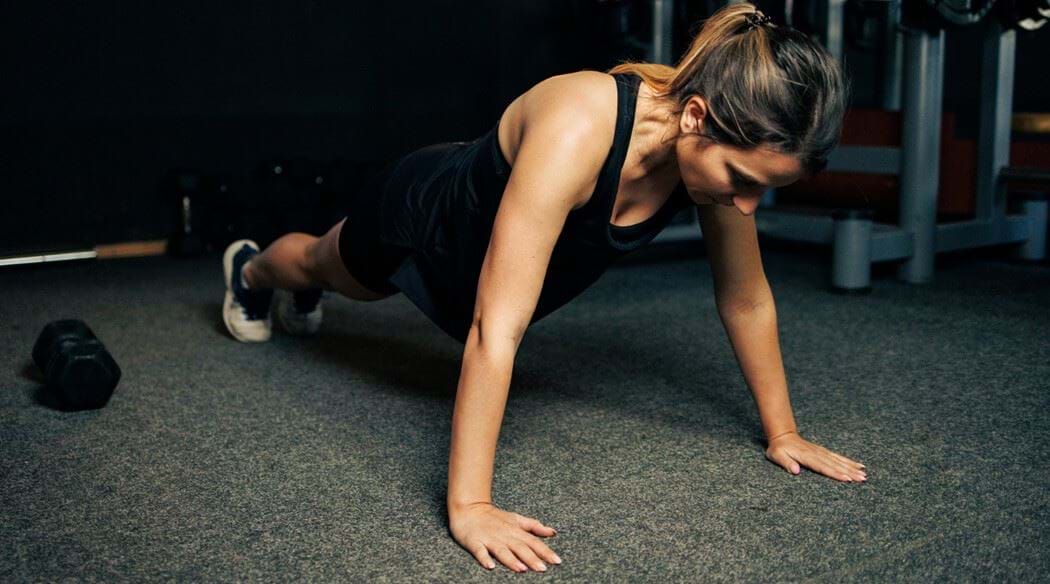
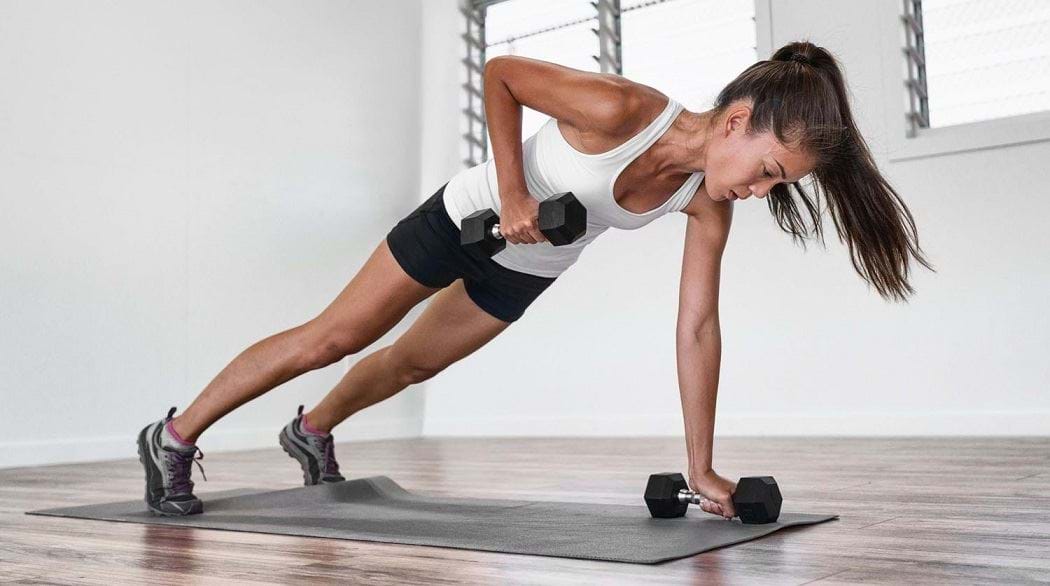
Set up in a high plank position, but holding onto dumbbells rather than hands flat on the floor
Perform a push-up by bending at the elbows to lower your chest, then pushing back up to plank position
Shift your weight onto the right hand and then row the left dumbbell up to your side by bending the elbow towards the ceiling
Return to plank and switch sides
Repeat
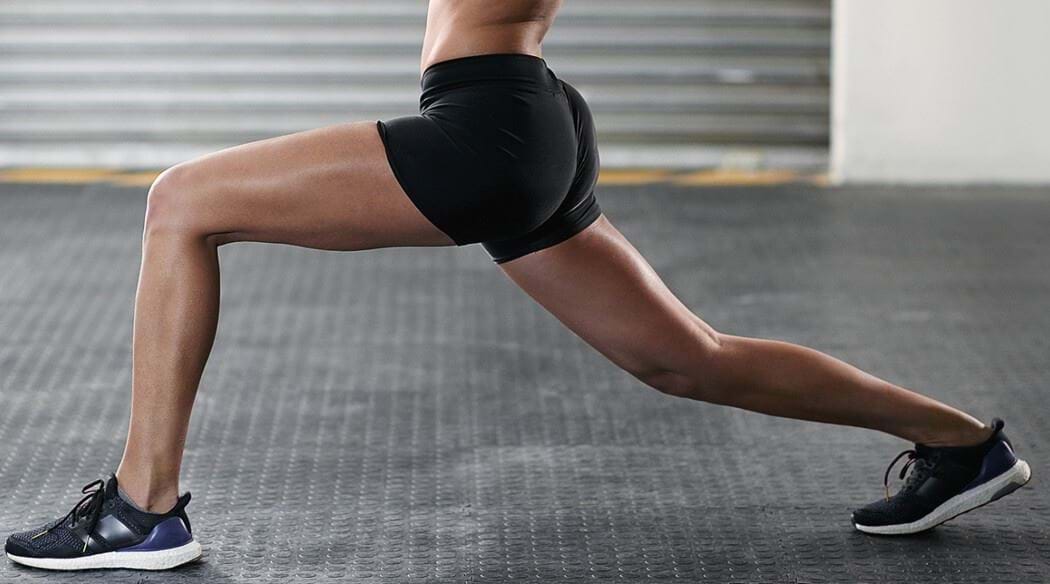
Hold a dumbbell in each hand by your sides and assume a hip-width stance
Shift your weight into your left foot and step your right foot back
Bend your left knee until your right knee is just off the floor, both knees at a 90 degree angle
Push up through the left foot and bring your right foot hip-width apart
Repeat on the other side
Get into a high plank position, making sure hands are shoulder-width apart, and core is engaged
Pull your right knee forward by squeezing it as close to your chest as you can
As you return the right leg, pull the left knee in, so that you switch legs at the same time
Cool down - 2 minutes
30 seconds jogging on the spot
30 seconds walking on the spot
30 seconds down dog
30 seconds child pose
If you enjoy this workout, we've shared more ideas for a HIIT workout with weights here.
Duration: 20 minutes
Equipment: Treadmill
Format: 30 seconds fast / 30 seconds slow × 12 rounds
Choose this workout if:
- You like structured sessions with precise speed or incline changes.
- You want a HIIT option that's simple to follow without learning new movements.
- You're aiming to improve running stamina, sprint power, or calorie burn.
- You prefer a workout that keeps your joints supported with smooth, repetitive movement.
We've not specified the running pace for this workout as it will depend on your current level of fitness. Choose a speed where you can run for the specified time, but only just.
The treadmill takes a few seconds to get up to maximum speed, so change speed just before the running time starts.
Warm up - 4 minutes
- Walk at a moderate pace (around 5-6kph) for 2 minutes
- Increase speed by 1kph and walk for a further 2 minutes
Workout - 12 minutes
- Run at maximum speed for 30 seconds
- Walk slowly (around 4kph) for 30 seconds
- Repeat 12 times
Cool down - 4 minutes
Walk at a moderate pace for 2 minutes
Decrease the speed and walk for a further 2 minutes
If you have the time, try adding these warm up stretches for runners after your 4-minute treadmill warm up.
20 minute HIIT workout for beginners
Duration: 20 minutes
Equipment: None
Format: 30 seconds on / 30 seconds rest; 5 exercises × 3 rounds
Choose this workout if:
- You're new to HIIT or returning after time off.
- You want simple, repeatable exercises with manageable intervals.
- You prefer a session that builds confidence without overwhelming intensity.
- You're looking for a routine that's easy to scale up as your fitness improves.
- You're keen to complete your HIIT workouts at home without equipment.
Warm up - 3 minutes
- 3 minutes on the treadmill, bike, or crosstrainer, or just jogging on the spot at moderate intensity
Workout - 15 minutes
Perform each exercise for 30 seconds at max speed, followed by a 30-second rest. Repeat the circuit 3 times.
Stand with feet hip-width distance apart, feet slightly turned out
Perform a normal bodyweight squat, maintaining a tall spine and braced core
As soon as your hip sinks just below the knees, push your heels off the floor by jumping as high as you can, and land softly on your feet
Get into a high plank position, making sure hands are shoulder-width apart, and core is engaged
Pull your right knee forward by squeezing it as close to your chest as you can
As you return the right leg, pull the left knee in, so that you switch legs at the same time
Stand with your feet together and arms by your sides
Jump up and push your feet out so that you land between hip and shoulder-width apart. As you jump, push your arms up to shoulder height
Jump again, this time bringing your feet back together, and arms by your sides
Repeat
Start by standing with feet hip-width apart
Squat down and place your hands on the floor in front of your feet
Place your weight into your hands and kick both feet back into a high plank position
Perform a push-up, then jump your feet back behind your hands and resume a squat position
As you stand back up, jump and reach your arms overhead
Land back into a squat position and repeat
Lie down on your back, feet on the floor, with knees bent towards the ceiling, and hands on the back of your head
Brace your core to press your lower back against the floor, then lift your head and neck off the floor
Pull your knees towards your chest to raise your feet off the floor
Exhale and bring your right elbow and left knee towards the mid chest until they touch. At the same time, straighten your right leg, making sure to keep your foot off the floor
Return to the starting position and repeat on the other side
Cool down - 2 minutes
- 2 minutes on the treadmill, bike, or cross trainer at low intensity
20 minute HIIT stationary bike workout
Duration: 20 minutes
Equipment: Stationary bike
Format: Sprint intervals (7 rounds) + hill intervals (7 rounds)
Choose this workout if:
- You want a low-impact session that's kind on knees and ankles.
- You enjoy workouts with quick changes in resistance and cadence.
- You're aiming for a strong cardio focus without running or jumping.
- You like a routine that feels controlled but still delivers a serious sweat.
Warm up - 3 minutes
- Cycle at a medium pace on a light resistance
Workout - 14 minutes
This workout is split into two parts: sprint intervals and hill intervals:
Sprint intervals:
30 seconds pedalling as fast as possible at medium resistance
30 seconds pedalling slowly at light-medium resistance
Repeat 7 times
Hill intervals:
40 seconds pedalling as fast as possible at high resistance
20 seconds pedalling slowly at light-medium resistance
Repeat 7 times
Cool down - 3 minutes
Cycle at a medium-slow pace on a light resistance
If you can stretch to 30 minutes, why not try one of our cycle classes? Our instructors will make sure you work your hardest and get the most out of this session.
FAQs about 20-minute HIIT workouts
How Many Calories Can I Burn In A 20 Minute HIIT Workout?
HIIT workouts can burn some serious calories in a short space of time. While this number will vary depending on factors like your weight and what type of HIIT you are doing, you can expect to burn around 150-400 calories in 20 minutes of HIIT. And that's without the extra calories burned throughout the day!
Is 20 Minutes of HIIT 3 Times A Week Enough To Lose Weight?
Yes, if you're in a calorie deficit. Exercise alone rarely drives large weight loss, but HIIT can make staying in a deficit easier by helping you burn more calories in less time. Research (including this study in the National Journal of Medicine) shows that people who combine exercise with dietary changes lose more weight and are more likely to keep it off than those who rely on diet alone. You can read more about calories and weight loss here.
Doing three 20-minute HIIT sessions a week can meaningfully increase your weekly calorie burn, especially if you don't have time for long workouts. HIIT is one of the most time-efficient ways to support weight-loss goals.
Can I Do 20 Minutes of HIIT Every Day?
Doing HIIT every day is not recommended.. HIIT is demanding, and doing it daily can increase your risk of injury, fatigue, and elevated cortisol (the stress hormone). Short spikes of cortisol are normal during intense exercise, but keeping levels high for long periods can lead to problems like poor recovery, low mood, and even weight gain.
Leave at least 48 hours between HIIT sessions so your body can recover properly. Aim for a mix of training across the week: a couple of HIIT sessions, plus strength training to build and maintain muscle, support bone density, and improve overall fitness. You'll get far better results from a balanced approach than from daily HIIT.
Do I need to warm up before a 20-minute HIIT workout?
Yes. Even if the workout is short, a warm-up is essential. HIIT involves fast, explosive movements, and warming up increases blood flow, prepares your joints and muscles, and reduces your risk of injury. A couple of minutes of light cardio and mobility is enough, and you'll perform better once the session starts. Read our ultimate guide to warm up exercises for more.
Can a 20-minute HIIT workout improve running or cycling performance?
Definitely. Short intervals at high intensity help you develop speed, power, and stronger cardiovascular conditioning, all of which transfer to running and cycling. HIIT improves how efficiently your body uses oxygen, meaning you can sustain faster paces or harder efforts for longer when you're back on the road, trail, or bike.
We have guides for HIIT cycling workouts, interval running workouts, and treadmill HIIT workouts you can check out for more HIIT inspiration.
What's the best way to progress a 20-minute HIIT workout over time?
There are several simple ways to make a 20-minute HIIT session more challenging:
- Increase the work interval or shorten the rest interval
- Add incline, resistance, or weight
- Choose more complex or explosive movements
- Add an extra round of your circuit
- Aim for more reps in each interval
Small, steady upgrades keep your workouts effective without needing to make them longer.
Is 20-minutes of HIIT effective if I don't sweat a lot?
Yes. Sweat isn't a reliable measure of how hard you're working because temperature, hydration, and environment all play a role. What matters is your effort level. As long as you're pushing close to your maximum during the work intervals and maintaining good form, a 20-minute HIIT workout will still deliver results.
Should I do a 20-minute HIIT workout before or after weight training?
It depends on your goal. If building strength or muscle is your priority, do weights first, while your muscles are fresh. If improving your fitness or calorie burn is the main focus, you can put HIIT first or even perform it on separate days. Either way, allow enough recovery so both parts of your session feel purposeful, not rushed.
Learn more about weight training and how to get started here. We've also shared some 30 minute HIIT workouts here.
If you find yourself inspired to try more HIIT workouts, check out our HIIT workouts for beginners blog. Plenty of our fitness classes follow a HIIT format too -- find your nearest gym and join one today!
Related Articles