Hiking Difficulty Index: The World's Hardest and Easiest Bucket-List Hikes Revealed
Hiking is one of the most exciting and rewarding ways to explore a country. You get to experience unrivalled views while giving your body a workout that very few gym sessions can match. A long day on the trail builds cardiovascular fitness, strengthens your legs and core, supports bone density, and is consistently linked to better mood, improved sleep and better mental clarity.
It's no surprise, then, that bucket-list hikes have increasingly become the centrepiece of holidays. Combining exercise with vacationing is something we've looked into before; most recently with our Marathon Difficulty Index (where we analysed the world's toughest and most PB-friendly marathons). Before that, we also analysed the World's Most Demanding Landmarks, where we highlighted the tourist attractions that require the most physical exertion to get to.
But back to hiking holidays. Searches for hiking holidays have increased in the UK in recent months. Terms such as "dolomites hiking holiday" have increased by 540% since March 2025, generating more than 400,000 searches in the same period. Most hiking destinations come with jaw dropping photo opportunities, which inspire more people to book hiking holidays as a result. What the photos often don't tell you is the journey it took to get there; the 3am starts, the hours of steep hills, and the narrow ledges.
This is where a lot of average hikers get caught out. Difficulty isn't just about distance. The hikes that humble people most often combine several factors at once: long distance, steep elevation gain, high altitude (where there's less oxygen in every breath), exposed scrambling sections that demand the use of your hands, and weather that can swing from calm to alpine in a matter of minutes. Cold and wind drain your energy and heat and humidity sap your pace, meaning even a "short" 4 km route can be punishing if it's straight up a ridge in 30 mph gusts.
Underestimating hikes also increases the chances of accidents and injury. Last year marked a record year for rescue operation incidents following a sharp 24% increase in callouts between 2019 and 2024.
But that doesn't mean these hikes are off-limits – far from it. With the right preparation, training and accessible gear (no ice axes needed here!), almost anyone can work up to a serious bucket-list trail. The aim of this index is to help you choose the right hike for your current ability, train smartly for the next one up, and step onto the trail with realistic expectations rather than getting stranded halfway up.
Key findings
Mount Kinabalu Summit on the island of Borneo, part of Malaysia, is the world's toughest bucket-list hike.
The most accessible bucket-list hike in the world is Horseshoe Bend in Arizona, USA.
Looking at the UK specifically, the analysis revealed Cuillin Ridge on the Isle of Skye in Scotland to be the UK's toughest bucket-list hike.
The hike around Buttermere Lake in the Lake District in England takes the spot of the UK's easiest bucket-list hike.
How we measured hiking difficulty
To find the world's hardest and easiest bucket-list hikes (the ones that are “amateur-level” and not requiring specialist training or equipment), we built a difficulty index analysing more than 130 trails across the globe. Each route was scored against nine metrics: distance, elevation gain, maximum altitude, gradient, the presence of scrambling, average annual temperature, average wind speed, average humidity and average monthly precipitation. Each metric was weighted equally and combined into a single total score out of 100, allowing us to compare a sea-level coastal walk in the Lake District against a 6,000-metre summit in Ladakh on a level playing field.
The result is a clearer picture of why some hikes feel disproportionately hard, and which hikes are genuinely accessible to inexperienced hikers, even when the postcard view is world-class.
The hardest and easiest hikes in the world
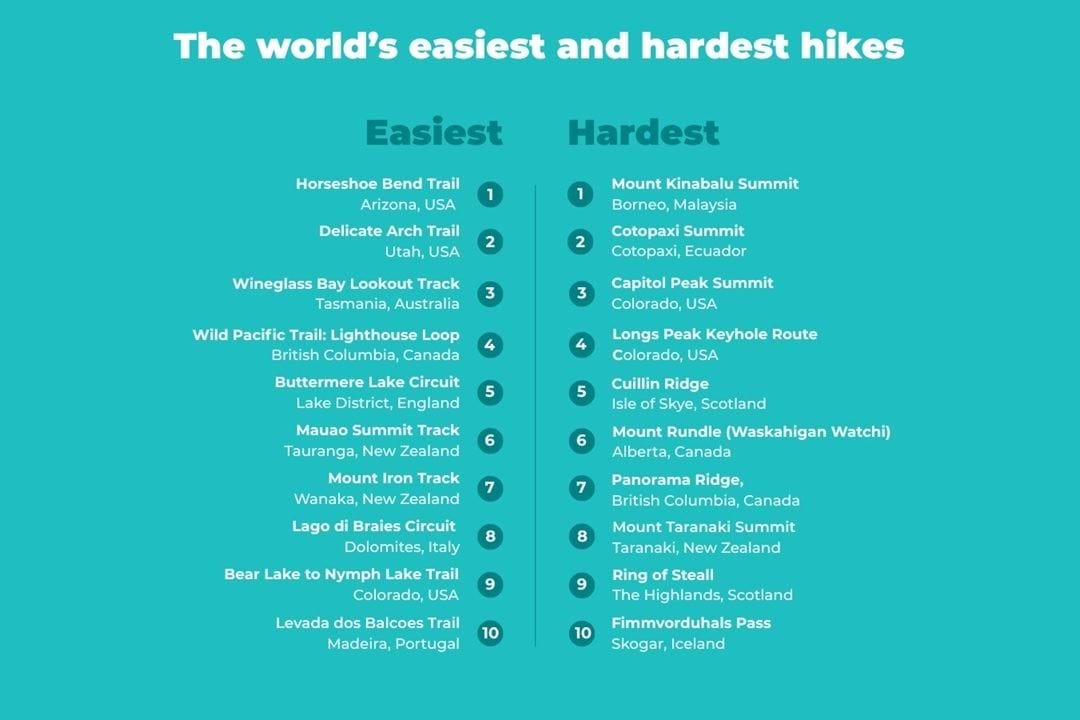
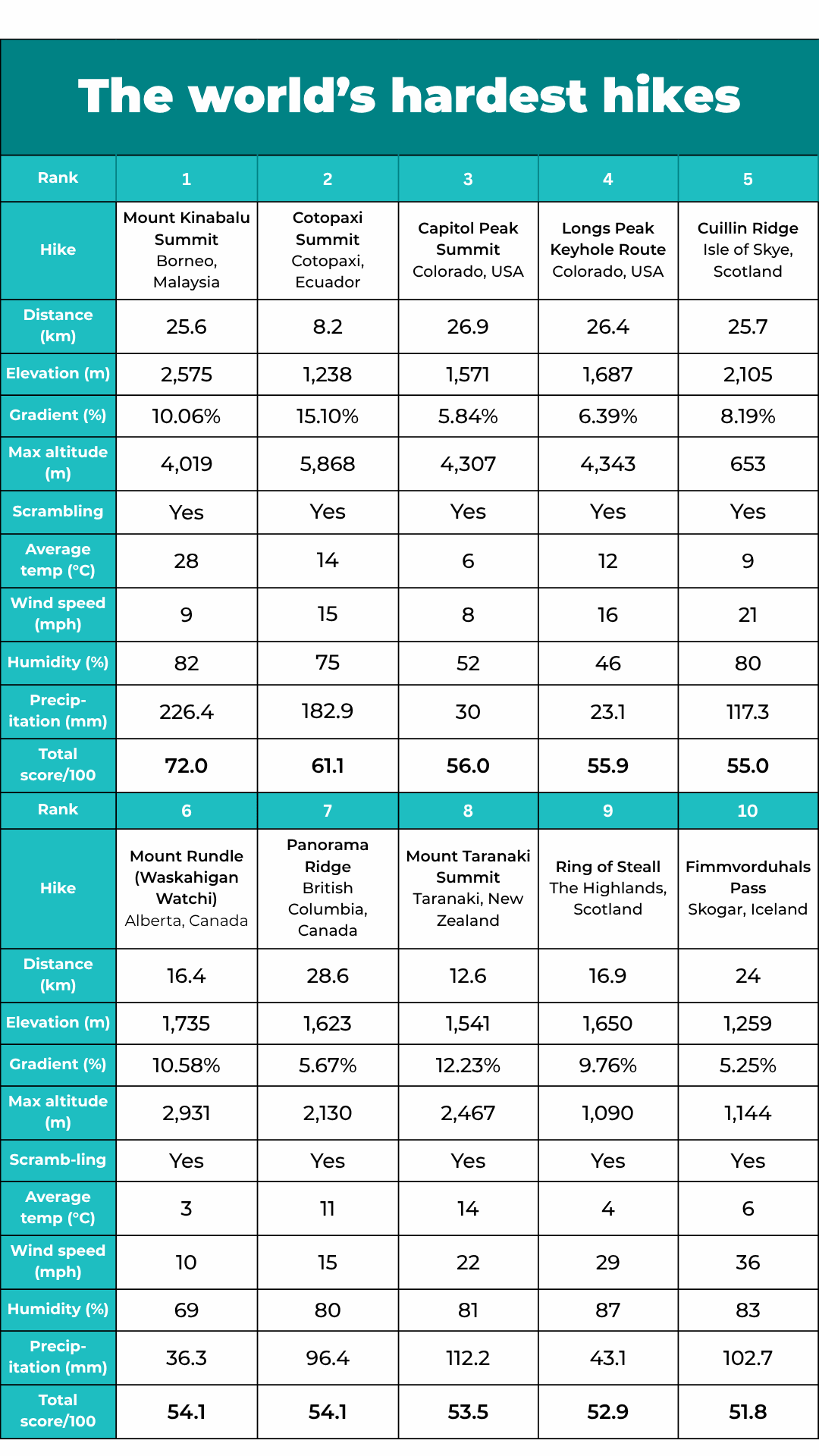
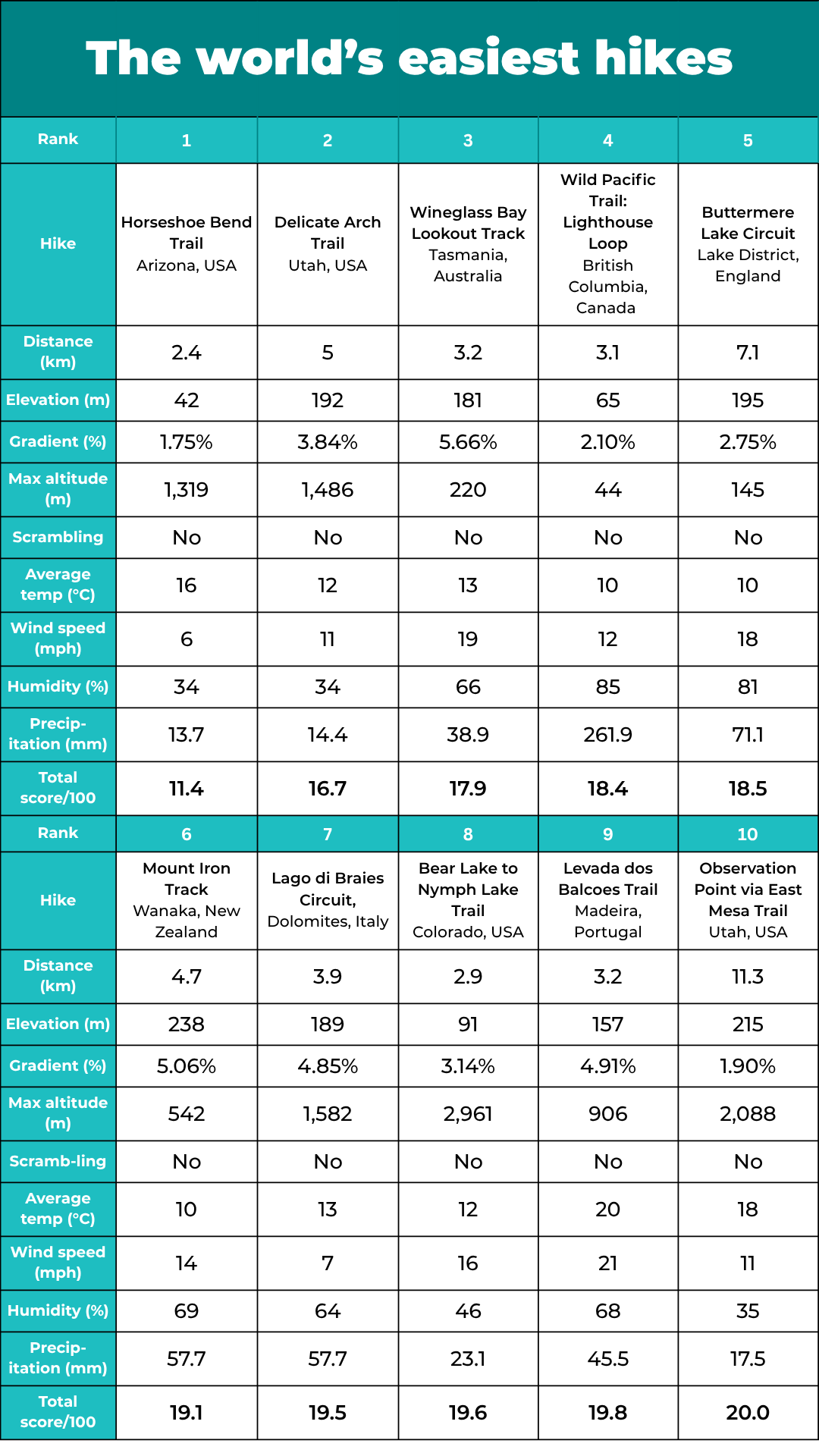
Keen to explore the entire list of hikes? You can access the dataset here.
The three hardest hikes in the world
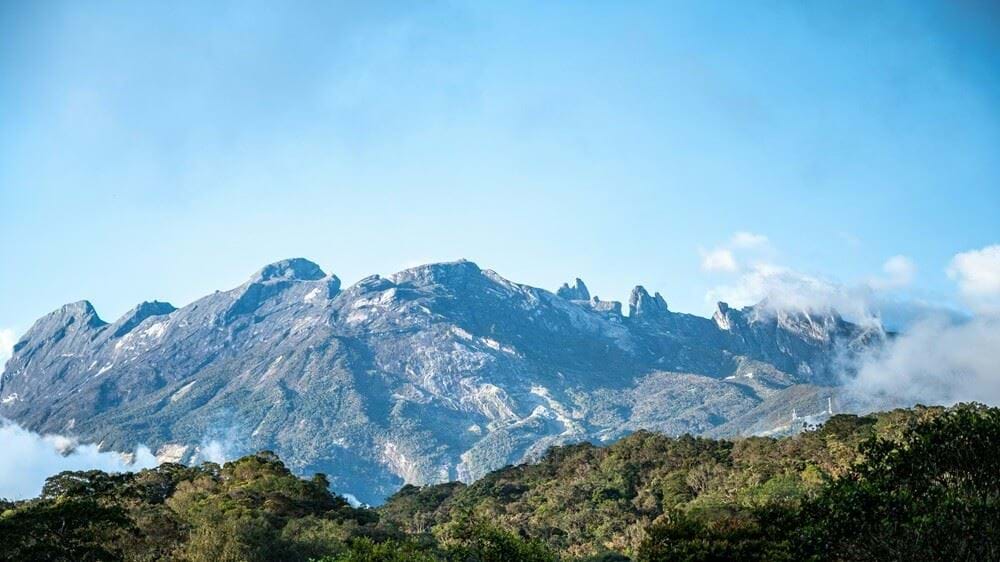
Mount Kinabalu Summit on the island of Borneo, part of Malaysia, which ranks as the world’s most difficult bucket-list hike in our analysis
Scattered all over the globe, the top 10 list is made up of hikes located in virtually every corner of the world. From the far north of Scotland, Canada and the US to the deep south of South America, Asia and Oceania, these hikes are as diverse as they are difficult.
Yet, the trails at the very top of our index share a common composition: serious distance, brutal elevation gain, thin mountain air, and at least one section where you're using your hands as much as your feet. These are not just your standard Sunday stroll, but hikes that require good fitness and respect for the mountains.
The best windows for these trails tend to be short: late June to mid-September for most of the northern hemisphere summits, and December to February for the ones in the southern hemisphere. Whichever you choose, make sure to check weather conditions before embarking on your hike to avoid any accidents.
Let's do a deep dive of the top 3 most difficult hikes.
1. Mount Kinabalu Summit, Borneo, Malaysia | Score: 72.0
Topping the rankings is Mount Kinabalu on the island of Borneo in Malaysia, where tropical heat plays its own role. High average annual temperatures of around 28°C combine with equally high humidity and steep scrambling and a 4,000-metre summit.
Distance: 25.6km
Elevation gain: 2,575m
Gradient: 10.06%
Maximum altitude: 4,019m
Scrambling: Yes
Average temperature: 28°C
Average wind speed: 9mph
Average humidity: 82%
Average precipitation: 226.4mm
2. Cotopaxi Summit, Cotopaxi, Ecuador | Score: 61.1
Next on the list is the Cotopaxi Summit in the Andes Mountains of Ecuador. The glaciated stratovolcano is climbable without any equipment or preparation, but it is often recommended to complete it with an experienced guide for a safe passage. Good fitness levels are also required to navigate the snowy terrain on the glacier.
Distance: 8.3km
Elevation gain: 1,238m
Gradient: 15.10%
Maximum altitude: 5,868m
Scrambling: Yes
Average temperature: 14°C
Average wind speed: 9mph
Average humidity: 82%
Average precipitation: 182.9mm
3. Capitol Peak Summit, Colorado, USA | Score: 56.0
Third on the list is the Capitol Peak Summit in Colorado's Elk Mountains. With one of the most exposed knife-edge ridges in the United States, we're not surprised. Colorado is full of "fourteeners" (summits over 14,000 feet), and the Capitol Peak Summit is considered one of the most beautiful (but challenging) to climb.
Distance: 26.9km
Elevation gain: 2,105m
Gradient: 8.19%
Maximum altitude: 4,307m
Scrambling: Yes
Average temperature: 6°C
Average wind speed: 8mph
Average humidity: 52%
Average precipitation: 30mm
The three easiest hikes in the world
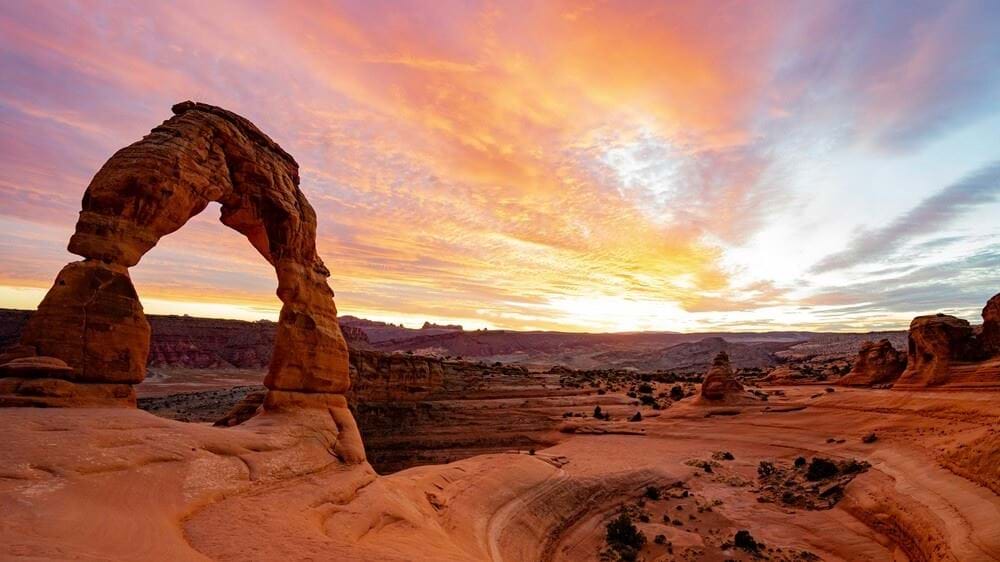
Bucket-list-worthy indeed! Delicate Arch in the Arches National Park in Utah is the second most accessible hike in the world, according to our research
While the above makes a great wish-list for seasoned mountain hikers looking for a challenge, this one is the opposite; a collection of incredible bucket-list views that are far more attainable. Most are short, low on elevation gain, free of scrambling, and set in stable, predictable climates. Several can even be done before lunch!
The top 10 are made up of hikes located all over the world, showing how there are ideal hiking terrains everywhere. The top two most accessible are both found in the US, with two more US hikes making up the top flight. Elsewhere, trails from Australia, Canada, England, Italy, New Zealand and Portugal can be found. Although diverse in their nature, they share factors that make them less demanding – short distances paired with low elevation and favourable weather conditions.
These hikes are perfect for a holiday, a family trip or anyone easing back into hiking. Spring and autumn are usually the sweet spots, avoiding the worst of summer crowds and heat in the desert routes.
Read on as we elaborate further on the 3 easiest hikes in our analysis.
1. Horseshoe Bend Trail, Arizona, USA | Score: 11.4
American trails make up the majority of the top 10 list. In first place is Horseshoe Bend in Arizona – a short, flat and sandy out-and-back route to a sheer cliff above a perfect U-bend in the Colorado River, which offers breathtaking views of the red, rocky landscape of vibrant Navajo sandstone.
Distance: 2.4km
Elevation gain: 42m
Gradient: 1.75%
Maximum altitude: 1,319m
Scrambling: No
Average temperature: 16°C
Average wind speed: 6mph
Average humidity: 34%
Average precipitation: 13.7mm
2. Delicate Arch Trail, Utah, USA | Score: 16.7
Delicate Arch in the Arches National Park in Utah makes up the second most accessible hike in our ranking, due to its short route, low elevation and favourable conditions. Ending up at the most photographed natural arch on the planet, the scenic reward is well worth the limited effort required getting there.
Distance: 5km
Elevation gain: 192m
Gradient: 3.84%
Maximum altitude: 1,486m
Scrambling: No
Average temperature: 12°C
Average wind speed: 11mph
Average humidity: 34%
Average precipitation: 14.4mm
3. Wineglass Bay Lookout Track, Tasmania, Australia | Score: 17.7
Third on the list is the Wineglass Bay Lookout Track on the Australian island of Tasmania, giving off picturesque views of Freycinet National Park, complete with white sandy beaches and blue waters. Despite the ascent, this trail is suitable for just about everyone.
Distance: 3.2km
Elevation gain: 181m
Gradient: 5.66%
Maximum altitude: 220m
Scrambling: No
Average temperature: 13°C
Average wind speed: 19mph
Average humidity: 66%
Average precipitation: 38.9mm
The 10 hardest hikes in the UK
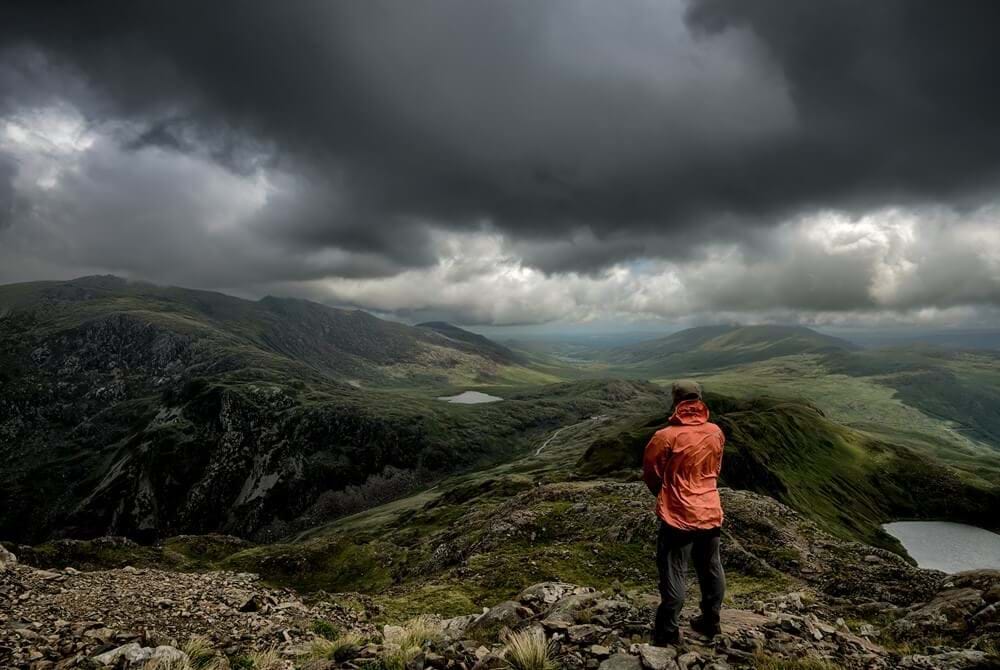
Moody views from Snowdon's Crib Goch Ridge, the fourth toughest bucket-list hike in our analysis
You don't necessarily need a passport to find a humbling hike – or indeed one of the best hikes in the UK. Britain punches well above its altitude on this index, and the reason is simple: when you combine sustained elevation gain, scrambling on exposed ridges and famously volatile weather, even seemingly modest mountains feel enormous.
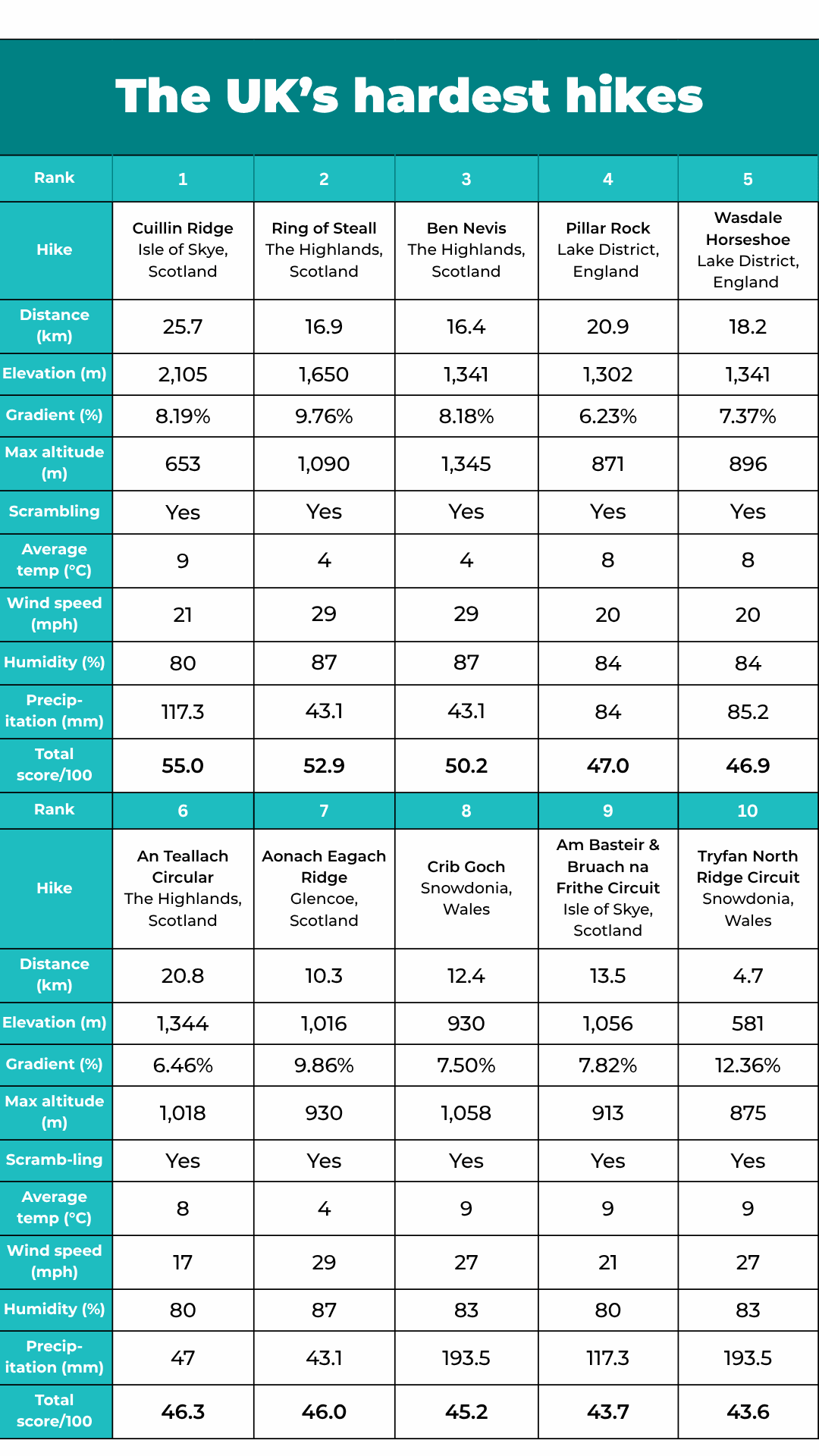
The Cuillin Ridge Traverse on the Isle of Skye in Scotland is the UK's hardest hike by some distance, and one of the toughest in the world. The full traverse covers roughly 25 kilometres with more than 2,000 metres of increased climbing, almost all of it on bare stone with multiple sections of rock climbing (classified as moderate-to-difficult). Scottish hikes make up more than half of the top 10 ranking, suggesting it's the area of the British Isles with the most challenging peaks.
Two Welsh peaks (Snowdon's Crib Goch Ridge and Tryfan's North Ridge), offer plenty of scrambling that also demand a head for heights, earning them their spots in the top 10 most challenging hikes in the UK.
Looking at England, two Lake District peaks, Pillar Rock and Wasdale Horseshoes (known to be one of the best hikes in the Lake District), also feature – they are long, lung-busting circuits with multiple summits and more than 1,300 metres of climbing in a single day.
Across the board, the defining factor isn't extreme heat or altitude – it's the relentless combination of vertical ascent, exposed terrain and weather that can change in the matter of minutes. The best window is May to September, with June often offering the longest daylight and the most stable conditions, but the volatile circumstances on a Scottish ridge can still feel autumnal at any time of year. Pack waterproofs, an extra warm layer, and a map and compass even if the forecast is clear.
The top 10 hardest hikes in the UK
The 10 easiest hikes in the UK
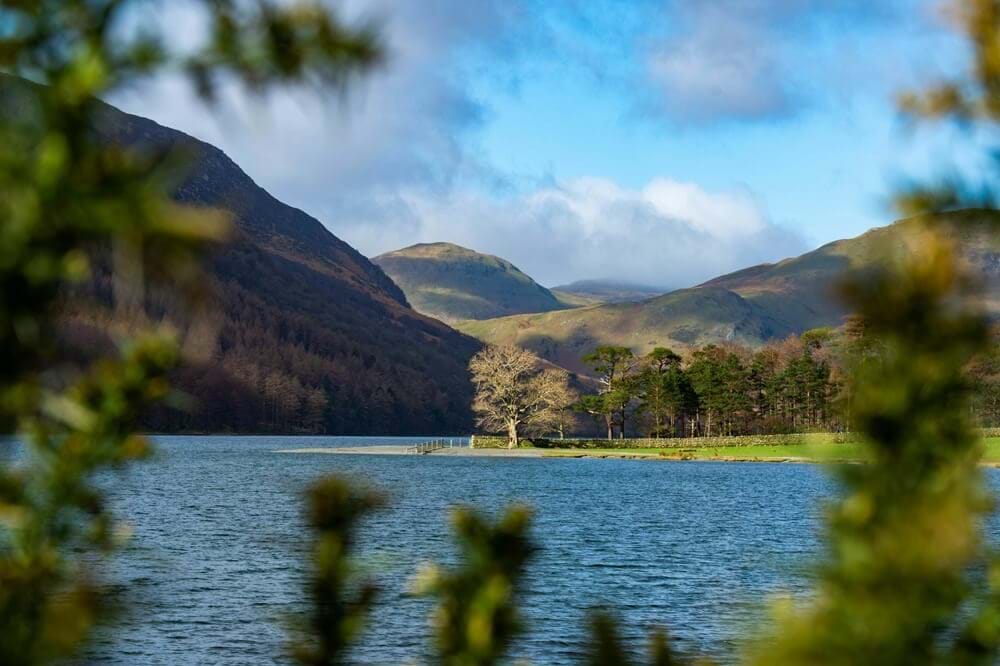
The loop around Buttermere Lake in the Lake District in England tops our list of the most attainable bucket-list hikes in the UK
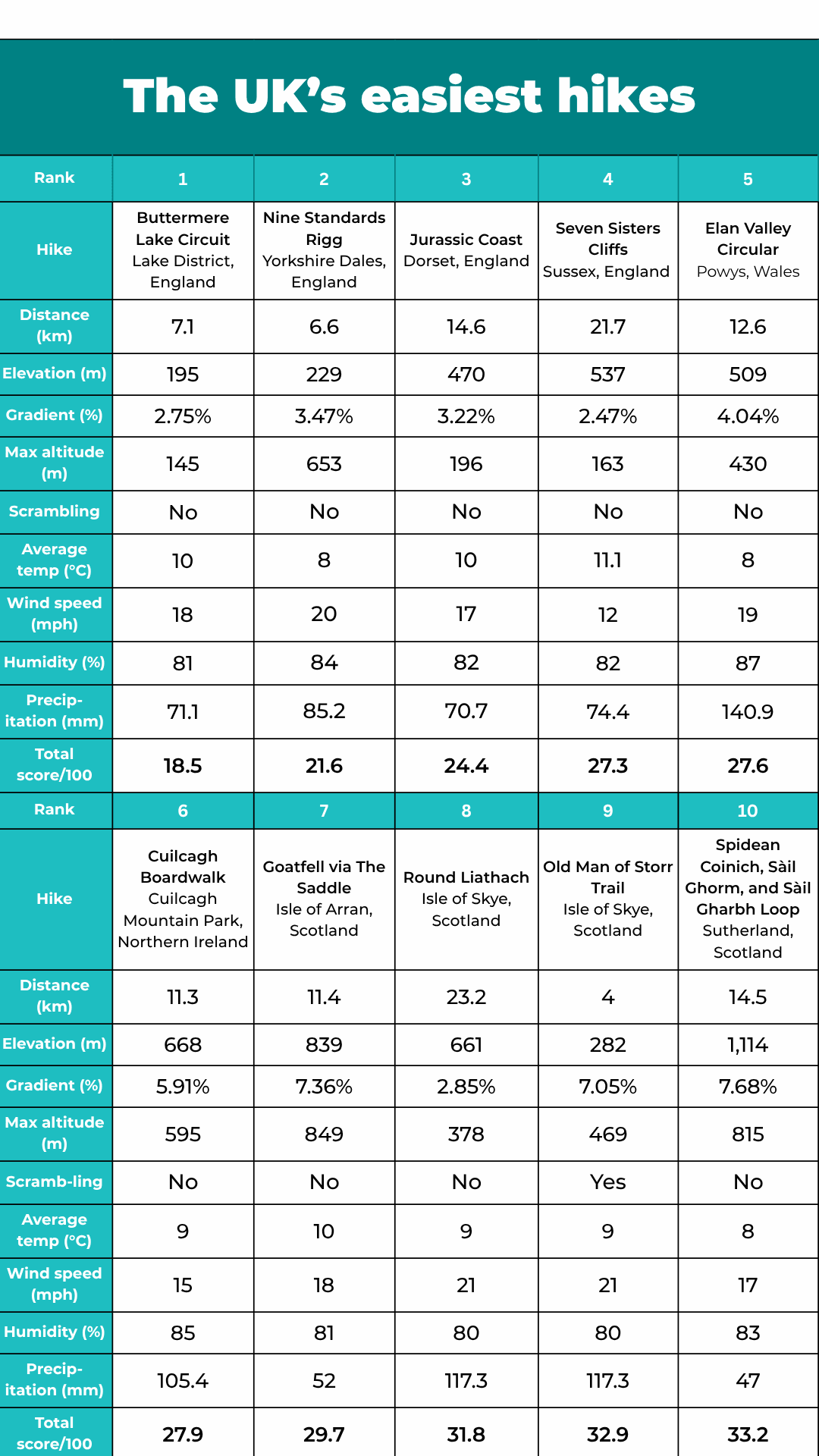
For every Cuillin Ridge, there's an alternative option that delivers genuinely beautiful scenery without asking you to scramble across an exposed ridge. These ten UK hikes are gentle on elevation, free of any scrambling and short enough to fit comfortably into a half-day, making them ideal for first-timers, families with younger walkers, or anyone using a calmer day to recover from a tougher outing earlier in the week.
The Buttermere Lake Circuit in the Lake District tops the list, its flat seven-kilometre loop around one of England's most photogenic lakes offering low elevation, light winds and zero scrambling. Next on the list is the Nine Standards Rigg in the Yorkshire Dales, followed by one of the best hikes in England, the Jurassic Coast path between Lulworth and Durdle Door. The latter delivers world-famous coastal scenery on a well-maintained track.
Scotland is well represented in this list too. The Goatfell via the Saddle on the Isle of Arran and Spidean Coinich to Sàil Ghorm to Sàil Gharbh Loop in Sutherland both look mountainous on the map but unfold gradually, on broad ridges with no tricky sections. Round Liathach and Old Man of Storr Trail, are both short summit walks that offer 10/10 views.
Northern Ireland's Cuilcagh Boardwalk (known as the "Stairway to Heaven"), uses a wooden walkway to make a once-boggy summit accessible even in trainers. The south coast of England also contributes the Seven Sisters Cliffs walk between Seaford and Eastbourne, a gently rolling clifftop route with mild temperatures and reliable footing year-round, while the Elan Valley Circular in Powys offers a quiet Welsh reservoir walk along forest tracks.
The best months for hikes in these locations are April to October, when daylight is generous and footing is dry. But even on the easiest hikes, sturdy footwear, a waterproof jacket and water are well worth packing – the British weather has a distinct (but charming) unpredictability about it.
The top 10 easiest hikes in the UK
How to train for a hike: a personal trainer's guide
A bucket-list hike does require some level of preparation to ensure you are fit and equipped for the challenge. The good news is that the training is straightforward, doesn't require expensive equipment, and brings a stack of everyday health benefits along the way.
You can find plenty of guidance on how to train for a hike across our site, for instance this 6-week hiking workout plan or this long-distance walking plan. But on top of that, Phil Carpenter, a PT and Assistant Gym Manager at PureGym Portsmouth North Harbour, shares his advice on how to set yourself up for greatness for your next descent. He breaks the work down into four core areas: cardio endurance, lower-body strength, core stability and trail-specific practice.
Build your engine: cardio
Hiking is endurance work, so you should aim to do two to three cardio sessions a week, at least one of which should be a longer, lower-intensity effort one. This can be a 60- to 90-minute walk on a treadmill with an incline setting, a stair climber session, or a long brisk walk outside. As the day of your hike approaches, start adding shorter interval sessions to strengthen your aerobic capacity. If you're training for an altitude hike, the most important thing is showing up day after day; you can't simulate altitude itself in a UK gym, but you can arrive at the trailhead with the strongest possible heart and lungs.
Strengthen the lift system: legs and glutes
Hiking, especially descents, punishes weak quads, glutes and calves. Two strength sessions a week, focused on compound movements (exercises that engage multiple muscle groups and joints at the same time), will pay off enormously. We’re talking squats, lunges, step-ups, deadlifts and weighted glute bridges here. Start with your own bodyweight then progress to dumbbells and work towards loaded carries (sandbags for instance) as you get stronger. This is to mimic potential backpacks you’ll be carrying on your hike. To that point, wearing a weighted backpack while doing your step-ups is particularly trail-specific and builds the exact pattern your legs will use on the hill.
Don't skip the core
A strong core keeps your posture upright on long days and stabilises you on uneven ground. Planks, side planks, dead bugs and Pallof presses will cover most of what you need. Two short core sessions a week (even as little as 10 minutes), make a measurable difference.
Practise on the actual terrain
Trail-specific training is the part most people skip. Once a week, try to get outside with the boots, socks and pack you'll be using on the trip. Practice walking on hills, even if you are in a cityscape. Walk up the hills with weight in your backpack, but also practice walking down the hills. Descents are where most blisters, knee pain and a drop in morale can appear. By the time you fly out, your kit should feel like an extension of your body, not a novelty.
Top tips for when you are on the trail itself
There are a couple of non-negotiables here. Remember to wear in your boots at home before heading out on a hike – only wearing them on day one of the trip is a guarantee for blisters. When it comes to clothing, layer up smartly with a moisture-wicking base (this could be an exercise top in polyester or nylon, or, even better, a wool layer), an insulating mid layer (such as a breathable fleece), and a waterproof top layer.
When it comes to fuelling, you need to hydrate steadily, sipping water every 15–20 minutes rather than gulping at rest stops; aim for around 500 ml per hour of moderate effort and more if it's hot. Eat little and often, ideally a mix of slow-release carbs (pre-made oats, wholegrain wraps, bananas) with occasional faster fuel (energy gels or trail mix).
Don't rush! Take breaks every 45–60 minutes to drop the pack, drink, eat 100 calories of something simple and check the map. Look after your feet by applying a dab of anti-friction balm on hotspots before they blister – this is one of the highest-value tricks in hiking!
The single biggest predictor of finishing strong isn't fitness, but it's pacing. If you start too hard, no amount of training will save you in the last hour. Start at a pace you could hold a conversation through, and you'll arrive at the viewpoint with energy left to enjoy it.
Feeling inspired to get fit for your next adventure? Find a PureGym near you to kickstart your journey to the top.
Methodology
To build the hiking difficulty index, we analysed nine terrain- and environmental-based metrics across 136 bucket-list hikes worldwide. The seed list was compiled from widely recommended bucket list hikes drawn from online travel sources, blogs and destination guides, but which generally do not require mountaineering equipment or are regularly attempted without any. Routes exceeding 30km were excluded to focus on single-day hikes.
For each route, we used AllTrails to report distance, elevation gain, maximum altitude and whether scrambling is required (we calculated the gradient manually dividing the distance by elevation gain). We then used timeanddate.com to source average annual temperatures, wind speed, humidity and monthly precipitation.
Where a hike can be completed via more than one route, the most popular trail on AllTrails was selected.
Each factor was assigned a weighted score contributing to a maximum possible total of 100 with higher scores reflect a more physically demanding hike: distance (20 points), gradient (20 points), elevation gain (15 points), maximum altitude (15 points), scrambling (10 points), average temperature (5 points), wind speed (5 points), humidity (5 points) and precipitation (5 points).
Seven factors (distance, elevation gain, gradient, maximum altitude, wind speed, humidity and precipitation) were scored linearly relative to the highest value recorded across all 136 hikes (formula: value ÷ global maximum × factor weight), so that the most extreme result in each category receives the full points available for that factor.
Scrambling was treated as a binary factor, scoring 10 where scrambling is required and 1 where it is not.
Temperature was scored using a bell-curve model centred on 14°C (the optimal hiking temperature), reflecting the principle that deviation from this temperature, whether too cold or too warm, increases physical demand. The maximum temperature score of 5 is awarded to the hike with the greatest deviation from 14°C across the full dataset.
The nine factor scores were summed to produce each hike's total difficulty score.
All data accurate as of June 2026.
Related Articles