The Best Lower Body, Bodyweight Workouts
Why Bodyweight | Benefits | Movement Patterns | Best Exercises | Sample Workouts | Structuring Workouts | Progressions | FAQs
Good leg workouts don't always need barbells or gym machines. A well-designed lower body bodyweight workout can build strength and improve mobility - all using just your own body weight instead of free weights.
We asked PureGym PT Chiara Albrizio to explain the key movement patterns to train, the best bodyweight leg exercises, and how to build lower-body workouts without equipment.
Quick summary
- Simple leg workouts at home without weights can support strength
- Lower body bodyweight workouts can build endurance, and mobility
- Bodyweight leg training targets quads, hamstrings, glutes, and calves
- Leg workouts using body weight should include squats and lunges
- Calisthenics for legs can build strong, functional lower body muscles
- Progressions like slower reps make workouts more challenging
Why do lower body bodyweight workouts?
Training lower body bodyweight movements can help to improve functional strength (for daily movements or sports), support joint health, and increase stability and balance.
Because leg workouts without weight rely on movement quality and time under tension rather than heavy resistance, they’re a great way to build mind-muscle connection, improve mobility, and perfect form.
Plus, you can do a no weight leg workout anywhere, making them convenient and accessible.
The benefits of bodyweight leg training
If you think you won’t get much from bodyweight leg training, think again. Here are some of the benefits you’ll see from lower body bodyweight workouts:
Increased strength and endurance
Lifting weights isn’t the only way to build strength. Doing bodyweight exercises for lower body can develop muscular endurance and help build strength over time.
Improved mobility
Because you’re not lifting heavy weights, bodyweight workouts are a great place to practice moving through your full range of movement and strengthening your end range, leading to greater mobility.
Muscle and joint stability
Bodyweight leg workouts use techniques like eccentric holds, slow tempos, and single leg variations to make exercises more challenging. These variations are excellent at building the smaller stabilising muscles and improving stability.
Convenience
Doing leg workouts at home without weights require very little space and no equipment, so they’re perfect for busy days when you can’t get to the gym, working out while traveling, or even getting some sunshine while you work out.
Essential lower body movement patterns to train
Thinking about your lower body in terms of movement patterns, rather than isolated muscles, is the good way to build balanced bodyweight leg workouts. This approach ensures all key muscles are trained together, improving coordination and movement quality as well as strength and mobility.
Squat pattern
Squatting is a functional movement we use every day in movements like sitting down and standing up from a chair. Squats engage all lower body muscles and strengthen the quads and glutes while improving balance and control
Slowing the lowering phase increases time under tension, making bodyweight quad workouts more effective.
Examples:
- Bodyweight squats
- Slow tempo squats
- Pause squats
Split stance
Life rarely happens with both feet evenly on the ground and including single-legged work is a great way to build strength and balance to handle all possibilities. These excellent bodyweight exercises for lower body are more challenging than as they require greater strength and stability in each leg.
Examples:
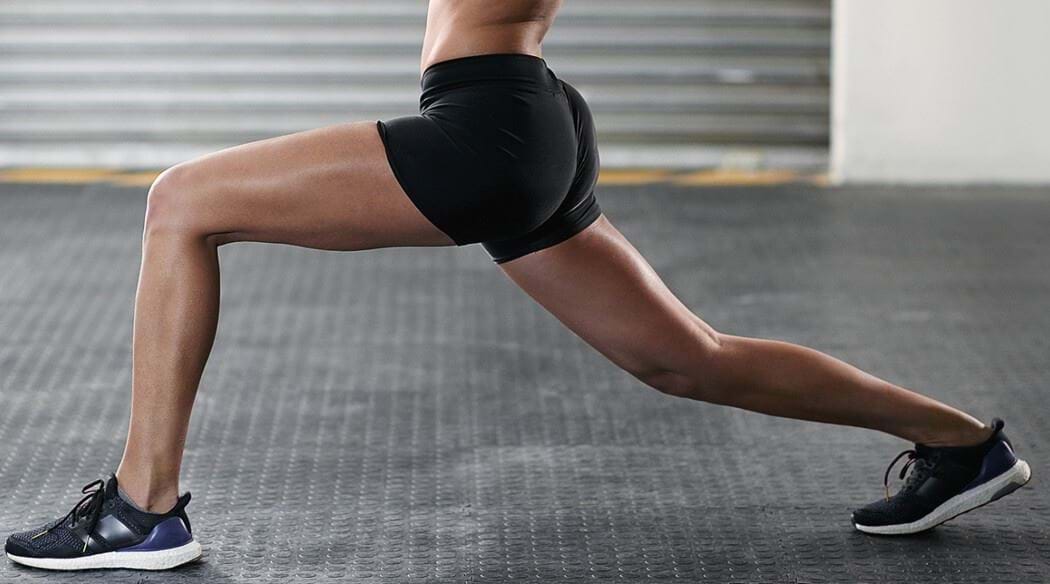
- Reverse lunges
- Static split squats
- Bulgarian split squats
Hip hinge
The hip hinge pattern strengthens the hamstrings, glutes, and spinal erector muscles, muscles which are often tight and weak from long periods of sitting. Including bodyweight posterior chain exercises can also improve lower back and hamstring flexibility.
Examples:
- Single-leg Romanian deadlifts
- Bodyweight good mornings
Hip extension
Your glutes power movements like climbing stairs or walking uphill. Many people wonder can bodyweight exercises build glutes, and the answer is yes, especially when you use tempo to increase the intensity.
Examples:
- Glute bridges
- Hip thrusts
- Single-leg glute bridges
Calf raises
Calves are important for balance and force absorption. Including bodyweight calf exercises help with ankle stability and overall lower body strength.
Examples:
- Standing calf raises
- Single-leg calf raises
Best bodyweight leg exercises for each muscle group
Now we’ve looked at the movement patterns, we can start to think about the best bodyweight leg exercises for different muscle groups of the lower body.
Quads
- Squats
- Step-back lunges
- Wall sits
Hamstrings
- Single-leg Romanian deadlifts
- Hamstring bridges
- Good mornings
Glutes
- Glute bridges
- Split squats
- Reverse lunges
Calves
- Standing calf raises
- Single-leg calf raises
Lower body bodyweight workouts for different goals
One of the benefits of bodyweight workouts is how versatile they can be. By changing the exercises and workout format, you can tailor your leg workouts for different goals.
Endurance
This balanced lower body bodyweight workout builds endurance and co-ordination and is a great foundation workout to have in your pocket.
Warm up
30 seconds jogging or marching on spot
30 seconds mountain climbers
30 seconds leg swings
30 seconds jump squats
30 seconds inchworms
Workout
Perform 3 rounds with 1 minute rest between each round
- Bodyweight squats - 12—15 reps
- Reverse lunges - 8—10 each leg
- Glute bridges - 12—15 reps
- Calf raises - 15—20 reps
Strength and hypertrophy
This workout uses supersets to maximise workout efficiency, as two exercises are performed back to back without rest. It focuses on single leg variations which are more challenging, making it ideal for building strength and muscle at home.
Warm up
30 seconds jumping jacks
30 seconds leg swings
30 seconds bodyweight squats
30 seconds alternating lunges
30 seconds hamstring scoops
Workout
Perform 2-4 rounds
Super set 1:
Bulgarian split squats — 8-10 each leg
Glute bridges — 12-15 reps
60 seconds rest
Super set 2:
Single leg RDLs — 8-10 each leg
Calf raises — 15-20 reps
Fat loss
This high intensity calisthenics leg workout raises the heart rate and burns calories in a short space of time, ideal if you're trying to lose or maintain your weight.
Warm up
30 seconds mountain climbers
30 seconds alternating lunges
30 seconds inchworms
30 seconds leg swings
30 seconds hip hinge
Workout
- Squats - 20 reps
- Reverse lunges - 12 each leg
- Glute bridges - 15 reps
- Calf raises - 20 reps
- Wall sit - 30—45 seconds
Calisthenics leg workout
Calisthenics is an ancient form of bodyweight training that blends gymnastics, strength, and full-body control. A structured calisthenics lower body workout can build strength, mobility, and co-ordination and is a fun way to train legs at home.
Warm up
30 seconds bear crawl
30 seconds leg swings
30 seconds Cossack squats
30 seconds alternating lunges
30 seconds deep squat to forward fold
Workout
Perform 2-4 rounds, with 60 seconds rest between each round
Pistol squats — 5-8 reps
Hamstring sliders — 8-10 reps
Around the clock lunges — 5 reps
Step ups — 8-12 reps
How to structure your lower body workout at home
To design your own balanced leg workouts at home without weights, make sure to include at least one exercise from each movement pattern we talked about earlier:
Squat pattern
Split stance
Hip hinge
Hip extension
Calf exercises
You can then decide on the format depending on your goal:
Straight sets: Doing an exercise for a defined number of sets and reps (e.g. 3 sets of 8-12 reps) followed by rest. This is great for strength and hypertrophy.
Supersets: Performing two exercises back to back. Also good for strength and hypertrophy and can reduce your workout time.
Circuits: Doing exercises for a period of time or number of rests, one after another, with rests between rounds. Good for fat loss and endurance.
Make sure to include 3-5 minutes of cardio and dynamic leg exercises to warm up, and follow the workout with some stretches to cool down.
Progressions to make bodyweight leg training harder
Adding weight isn't the only way to progress exercises. Here are some ways to keep leg training without weights challenging:
Change the tempo: Slowing down the lowering phase of the movement or adding pauses at the bottom increases the time under tension and makes exercises harder.
Increase volume: Add more reps or sets to increase the volume of your workouts.
Reduce rest time: This fatigues the muscles and makes the workouts more intense.
Do single leg variations: Single leg variations require more strength and stability, making the muscles work harder.
Lower body bodyweight training FAQs
Yes. With good exercise selection and progression, bodyweight leg exercises can build strength and muscle.
2-3 leg sessions a week is a good starting point, allowing time for recovery between workouts. This can be just bodyweight workouts or a combination of bodyweight and weights.
Yes, a structured calisthenics lower body workout including squats, lunges, hip hinges, and calf work will train all major leg muscles.
Yes. Bodyweight leg training can be good for endurance activities by strengthening supporting muscles, improving joint stability, and helping you generate more power. Try not to do both workouts in the same day.
Yes. A short warm-up makes the muscles warm and engaged, reducing risk of injury and increasing the effectiveness of your workouts.
Looking for more workouts to try? Here's a beginner friendly leg workout with weights you can alternate with your bodyweight leg workouts, or for more bodyweight workouts check out our calisthenics workout guide here.
Related Articles