Gym Exercises And Workouts To Improve Your Posture
What Causes Poor Posture | How Exercise Helps | Benefits | In The Gym | Best Gym Exercises | Best Home Exercises | Beginner Friendly Posture Workout | Common Mistakes | How Long To Improve | FAQs
Posture is one of those things we don't notice until it's too late. Whether you're 18 or 80, poor posture can cause a myriad of issues that affect your quality of life. Luckily, posture is something that can be improved with exercise.
Read on to learn why posture and exercise are linked and discover the best exercises for good posture, including a beginner-friendly posture correcting workout.
What causes poor posture?
One of the most common causes of poor posture is muscular imbalances, often caused by a sedentary lifestyle.
When you are sat down, especially if you're hunched over a phone or desk, the muscles in the front of your body (the anterior chain) are contracted in a shortened position and the muscles in the back of your body (the posterior chain) are switched off and lengthened.
If you spend long periods of the day sat down, over time the anterior muscles become chronically tight and the posterior muscles weaken. This imbalance pulls the spine and pelvis into poor alignment. Workouts to fix posture aim to stretch and strengthen the appropriate muscles to fix these imbalances.
The most common muscle imbalances that impact posture are:
Tight hip flexors and weak glutes: When you are sat for long periods, the hip flexors are stuck in a short position while the glutes are turned off. This leads to tight hip flexors and weak glutes which are no longer able to stabilise and support the pelvis and lower spine.
Tight chest and weak upper back: Hunching over a desk or slouching on your phone causes the muscles in the chest and front of shoulders to tighten while the muscles in the upper back, neck, and back of shoulders become weak and stretched. This causes the rounded shoulders and forward head position that are often seen in poor posture.
Weak core and spinal erector: When sat down, the core muscles switch off as they do not need to support the spine, so they become weak. The spinal erector muscles also weaken as they are kept in a stretched, inactive position.
How can exercise improve posture
Posture correcting workouts address these muscular imbalances by strengthening the posterior chain and the core so that they can support the spine and stretching the anterior chain muscles, so they are no longer pulling the spine out of alignment.
While you can use workouts to help posture, you can also make poor posture worse with your workouts. Strengthening the anterior chain muscles while neglecting the posterior chain, poor technique, and incorrect alignment can all worsen posture.
Benefits of better posture
Relieving back pain or improving aesthetics are some of the main reasons people want to improve their posture, but there are multiple ways you can benefit from better posture:
Reduced muscle tension: Poor posture can lead to chronic muscle tension, causing body wide aches and pains as well as tension headaches.
Easier breathing: Slouching compresses the lungs and reduces how much they are able to expand. Improving posture allows you to take deeper breaths and increase your oxygen intake. This boosts everything from energy levels and focus to recovery.
Better circulation: Hunching and slumping compresses blood vessels, making it harder for blood to flow to the muscles and organs.
More energy efficiency: When we have good posture, our bones and joints are in the correct alignment and it takes less energy to move them.
Decreased back pain: Poor posture puts extra pressure on the ligaments, bones, and muscles in the spine and can cause pelvic instability, all which can cause back pain.
Why improving posture matters for your fitness goals
Poor posture can impact how your body feels day to day, but did you know it can also impact your workouts?
Exercise and posture have a two-way relationship: while exercise can make posture better (or worse!), poor posture can negatively impact your workouts in a few ways:
- Muscle engagement: Poor posture often means that the intended muscles are not engaged in an exercise, either due to alignment issues or due to them being too weak. To complete a lift, other muscles then have to overcompensate. More often than not, the muscles overcompensating are the muscles which are already strong and tight due to poor posture, inadvertently worsening posture as a result.
- Mobility: Posture impacts our range of motion, with poor posture limiting our mobility. This can mean an inability to lift through a full range which reduces how effective an exercise is.
- Power and strength: Good alignment and muscle engagement is key to producing force efficiently. Poor posture reduces how much strength and power you can produce during a lift.
- Risk of injury: Working out with bad posture makes it harder to lift with correct form and increases the strain put on the spine and the supporting muscles, increasing the risk of injury.
Having good fitness posture means your workouts are more effective, giving you better results in the gym.
Best gym exercises to help posture
Because there are multiple muscular imbalances that can result in bad posture, there is no one single best exercise that will fix bad posture. You’ll need to include a variety of exercises that stretch and strengthen these muscles.
Here are some of the best gym exercises to include in your workouts to help posture to address the different muscles involved.
Deadlifts
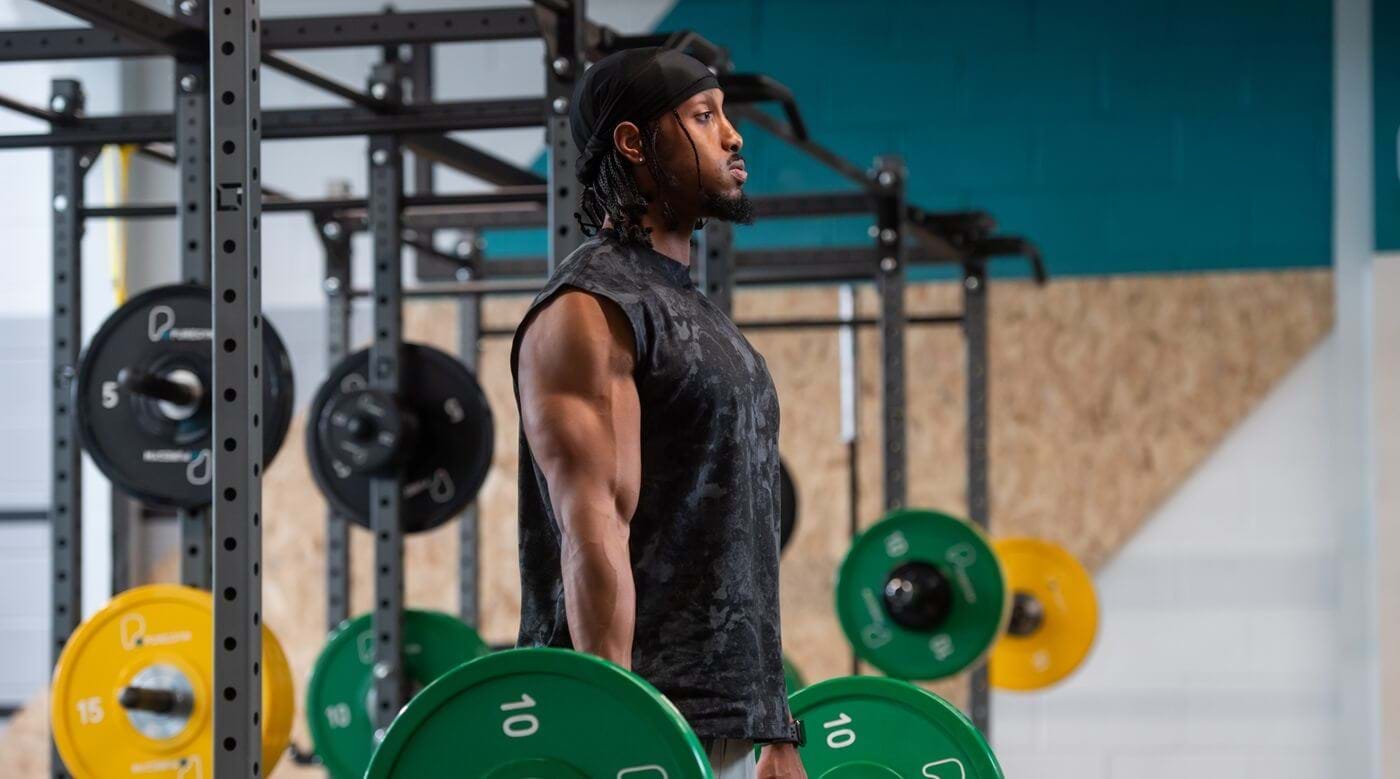
Deadlifts are one of the best posture correcting exercises you can do as they work the entire posterior chain, including the hamstrings, glutes, spinal erector and trapezius muscles. When weakened, these muscles are key contributors to poor posture and issues like spinal lordosis.
Deadlifts are particularly helpful for poor posture in the lower spine by addressing weak glutes and tight hip flexors, but can also help with rounded shoulders by strengthening the upper back.
To perform standard deadlifts:
Load the bar and set it on the ground. Then position your feet about shoulder-width apart, with the bar resting over your mid-foot. Drop down by hinging your hips backwards, grab onto the bar with your hands at about shoulder width, squeeze the bar tightly, and lift it by driving up through your heels.
Throughout the movement, your core should stay engaged, and your back should stay flat, not hyperextended or curved. Check out our deadlift exercise page for different variations of the deadlift.
Kettlebell swings
The kettlebell swing also strengthens the full posterior chain and helps to address these muscular imbalances. Kettlebell swings also require you to generate and manage high levels of force while keeping the torso stable. This strengthens and stabilises the core muscles so they are better able to aid good posture alignment.
To perform a kettlebell swing:
Grab a kettlebell with both hands. Keeping the legs mostly straight, "explode" the weight up in front of you, using a sharp movement of the hips, ending with a tight core as if you were performing a plank. Then, keeping your legs mostly straight and your back flat, allow the weight to swing down between your legs before repeating for the next rep.
When done right, a kettlebell swing is pretty much direct training for "standing up straight".
Kettlebell swings are a high-intensity exercise, which will work your cardio conditioning dramatically. Perform at slightly lighter weights and higher reps if you're prone to joint pain when performing heavy deadlifts. To see a video demonstration of this exercise, click here.
Hip thrusts
Weak and underactive glutes are a primary cause of poor posture in the lower spine and pelvis. Hip thrusts are one of the best ways to strengthen the glutes and train hip extension to directly combat long periods of sitting in hip flexion.
To perform hip thrusts:
Sit on the floor with your shoulder blades resting on the edge of a box or bench. Place both feet flat on the floor, hip width apart - you should be far enough from the box that your shins are vertical at the top of the exercise. Tuck your pelvis under to prevent your lower back from arching and push through your heels to press your pelvis towards the ceiling, before slowly lowering down. You can use weights to make this more challenging once you have the technique right.
Straight leg lunge
This lunge variation requires you to take a bigger step forward and keep the back leg straight, rather than bending both knees. Keeping the back leg straight while you lower your hips stretches the hip flexor while strengthening the glutes and core and building spine and pelvis stability.
How to perform straight leg lunges:
Stand tall with feet hip width apart and core engaged. Take a long step forward and bend your front knee to lower your hips. As you lower down, keep your torso upright and engage your back quad to keep your back leg straight. Stop when you are no longer able to keep the leg straight and push through the front heel to return up.
Seated cable rows
Having rounded shoulders are commonly seen in people with poor posture and are primarily the result of a weak upper back and tight chest. The seated cable row is a great way to strengthen the upper back and teach your body the action and engagement required to pull your shoulders back into alignment.
To perform seated rows:
Position yourself on the seat of the rowing machine, and grab the handle attached to the cable. Push back with
Chest flyes
With poor posture, the chest muscles are strong in a contracted (short) position but weak in a lengthened position. Chest flyes help to address rounded shoulders by stretching tight chest muscles and strengthening them in this lengthened position, allowing the shoulders to retract fully.
To perform chest flyes:
Lay flat on the floor or a bench with a dumbbell in each hand held. Press the dumbbells straight above your chest so your palms are facing each other. Keeping the core engaged and arms straight, slowly lower the dumbbells in an arc until they are parallel to the ground. Squeeze your chest muscles to bring the dumbbells back together.
To improve posture, start with a weight light enough that you can get the full range of movement and ensure you can keep the full range even when you progress the load.
Simple exercises to improve posture at home
If you want to get serious about improving your posture, there are simple posture exercises you can do at home each day to gently correct muscular imbalances and compensate for long periods of sitting.
While gym workouts strengthen the muscles, adding in a few exercises to improve posture throughout the day stretches tight muscles and engages weak muscles periodically, so they are less prone to getting ‘stuck’ in poor alignment.
Some exercises for better posture you can do at home are:
Wall angels
Wall angels strengthen the upper back and improve shoulder mobility, helping to correct rounded shoulders.
To do: Stand with your head, shoulders, back, and glutes against the wall, feet slightly in front of you. Keeping your elbows, wrists, and back of hands touching the wall if possible, bend your elbows to 90 degrees and raise your arms so that your elbows are in line with your shoulders. Keeping in contact with the wall if possible, raise your hands up above your head while straightening the elbows slightly. Slowly return to the starting position.
Floor Y raises
Y raises strengthen the upper back, rotator cuff, and back of shoulders so that the muscles can support the spine in the correct position rather than slouching over.
To do: Lie face down on the floor with arms extended overhead to make a 'Y' shape and thumbs turned towards the ceiling. Gentle resting your forehead on the floor, lifting your arms up off the ground and squeeze the shoulder blades together. Slowly return back to the start.
Planks
Planks are an anti core exercise, meaning they the core works to resist movement. Anti core exercises are great for building the core strength and stability needed to stabilise the spine.
To do: Start by kneeling on all fours with wrists, elbows and shoulders aligned. Step both feet back so that your body is in a straight line from head to heels. Keep the core, glutes, and legs engaged to stop your hips sagging, and hold.
Glute bridges
Glute bridges activate and strengthen the glutes and gentle stretch the hip flexors. This is a great exercise to do regularly if you sit all day or have trouble engaging your glutes in other exercises.
To do: Lie on your back and place your feet flat on the floor, hip width apart behind your glutes so your knees are bent towards the ceiling. Engage your core and tuck your pelvis under then push through the heels and squeeze your glutes to lift your hips up. Slowly lower back down, keeping a neutral spine throughout.
Banded pull aparts
Banded pull-aparts strengthen the upper back and rotator cuff while stretching the chest, helping to counteract hunched shoulders.
To do: Hold a resistance band with both hands in front of your chest at shoulder height with a soft bend in your elbows. Pull the band by squeezing your shoulder blades together and moving your hands outwards. Pause before slowly returning back to the start.
Dead bugs
Dead bugs build core stability and control and trains the muscles to hold a neutral pelvic position, combating excessive arching in the spine.
To do: Lie flat on your back with your arms straight above your chest and knees and hips bent so your legs are off the floor. Engage your core to press your lower back into the floor and slowly lower your right arm and left leg towards the floor, stopping when you can no longer keep your back on the floor. Return to the start and repeat on the other side.
Cobra stretch
In addition to strengthening exercises, stretching throughout the day can relieve tight muscles and stop them from becoming chronically tight. Cobra stretches the entire back and hip flexors, making it a great exercise for helping posture.
To do: Lie on your front with legs extended and hands under your shoulders. Push through your palms to bring your chest off the ground while keeping your hips and legs on the floor. Pull through the shoulders to push your chest forward and look towards the ceiling.
Puppy pose
Puppy pose stretches the shoulders and chest, helping to counteract hunched shoulders.
To do: Start by kneeling with hands under shoulders and knees under hips. Walk your hands forward and slowly lower your chest to the floor, keeping your shoulders relaxed. Rest your forehead, chin, or chest on the floor and hold.
Kneeling hip flexor stretch
This 90/90 lunge stretches the hip flexors to help with poor pelvis and lower back posture.
To do: From kneeling, step one foot forward so both knees are bent 90 degrees with the back knee on the floor. Tuck your pelvis under and engage the core then gently push your hips forward, keeping your torso upright.
Full body posture workout plan
Adding in a couple of fix posture exercises to your standard workouts and throughout the day can help with poor posture, but if you want to see results quicker you can try doing a dedicated workout for good posture one to two times a week on top of daily exercises.
This 20 minute workout for good posture is beginner friendly and addresses all the possible muscular imbalances that can cause bad posture. Focus on controlled movements with good form rather than heavy weights.
Warm up:
3-5 minutes moderate cardio
Cat-cow — 10 reps
Mobility and activation:
Superman — 10 reps
Dead bugs — 10 reps
Floor Y raises — 10 reps
Glute bridges — 10 reps
Repeat for two rounds
Strength:
Seated cable rows — 3 x 10-12 reps
Barbell hip thrusts — 3 x 10-12 reps
Chest flyes — 3 x 10-12 reps
Bulgarian split squats — 3 x 10-12 reps
Kettlebell swings — 3 x 15 reps
Cool down:
Cobra stretch — 30 seconds
Puppy pose — 30 seconds
Kneeling hip flexor stretch — 30 seconds
Common posture mistakes to avoid in the gym
Maintaining good posture in the gym helps to prevent injuries and ensure you are engaging the correct muscles. Some common mistakes include:
Poor core engagement: Having an engaged core is key to protecting the spine during lifts. To correctly engage your core, imagine you are about to be hit in the stomach. This act of tensing braces the core muscles and stabilises the spine.
Forward head: Having a forward head posture strains the neck and shoulders and reduces engagement from the back muscles. Consciously align your head over your tailbone and keep a light tuck of the chin.
Excessive arching: Over arching the back is common and puts excessive strain on the spine. Lightly tuck your pelvis under and engage the core to prevent this.
Rounded shoulders: Rounding or shrugging the shoulders engages the chest and shoulders rather than the upper back. Focus on bringing your shoulder blades back and down to allow a neutral spine.
Knowing the correct form and technique for the exercises you do is key to helping posture when lifting weights. Choose a weight that allows you to maintain good posture and form throughout all your reps.
How long does it take to improve your posture
Fixing your posture is not something that can be done overnight. Just as it takes time to develop bad posture, it takes time (and effort!) to fix it. For mild cases, bad posture can be improved in as little as a few weeks to a couple of months, while more severe posture issues can take 6-12 months or longer.
There is no set timeline for fixing bad posture but if you are doing regular posture exercises and breaking up long periods of sitting throughout the day, you can expect to see improvements as follows:
Month 1: Your body awareness improves, helping you to maintain better posture with conscious effort.
Month 2 +: As you build posterior strength and anterior flexibility, it becomes easier and more natural to hold good posture.
Month 6 onwards: Your muscles and fascia adapt so that your posture becomes permanently improved.
How to improve your posture quickly:
To improve your posture as quickly as possible, make sure you are doing regular strengthening and stretching exercises to combat poor posture. It’s also important to tackle the cause of bad posture: a sedentary lifestyle. Aim to get up and move, stretch, or change positions every hour rather than spending long periods sat in the same position.
FAQs on exercises for improving posture
To improve posture, choose exercises that strengthen the posterior chain such as deadlifts, hip thrusts, and rows. This helps to correct the muscular imbalances that cause hunched shoulders and tight hips.
Posture exercises are strength training exercises that focus on strengthening specific muscles to address poor posture. While it is a form of strength training, the goal is to improve posture rather than grow muscle mass or get stronger in the gym.
Although exercise can help posture, some workouts may worsen poor posture. Training with bad form or focusing only on strengthening the anterior muscles such as the chest and shoulders can make muscular imbalances worse. To help with posture, focus on stretching the chest and hips while strengthening the back and glutes.
You can do posture fixing exercises and stretches daily but if you are doing more intensive posture correcting workouts, stick to 2-3 times a week.
Posture exercises can help with back or neck pain, especially when the cause is weak and imbalanced muscles related to poor posture. Not all neck and back pain can be fixed with exercise — if you experience sudden sharp pain or pain that doesn't improve within a few weeks, speak to a medical professional.
Good posture requires a healthy balance between the anterior and posterior muscles along the entire body. Most people can benefit from strengthening the core, glutes, back, and shoulders while stretching the hip flexors and chest.
It's never too late to improve your posture, but the earlier you start the better. Find your nearest gym to get started today.
Related Articles